Why Does Air Fryer Cook Faster Than Oven: Explained
Introduction
In U.S. kitchens, an air fryer often cooks food faster than a full-size oven because it uses a small cooking chamber, a strong fan, and a heating element placed close to the food. These features move hot air across the food more quickly and reduce the time needed to heat the appliance.
An air fryer is not a different kind of heat. It is a compact convection oven. Its speed comes from how efficiently it transfers heat, not from a special cooking method.
The exact time still depends on the food, load size, starting temperature, appliance design, and cooking temperature. A crowded basket can cook more slowly than a spacious oven tray.
The Short Answer: Air Fryers Transfer Heat More Efficiently
An air fryer cooks faster than a conventional oven mainly for four reasons:
- Its small chamber heats quickly.
- Its fan moves hot air rapidly around the food.
- The food sits close to the heating element.
- The basket exposes more of the food to circulating air.
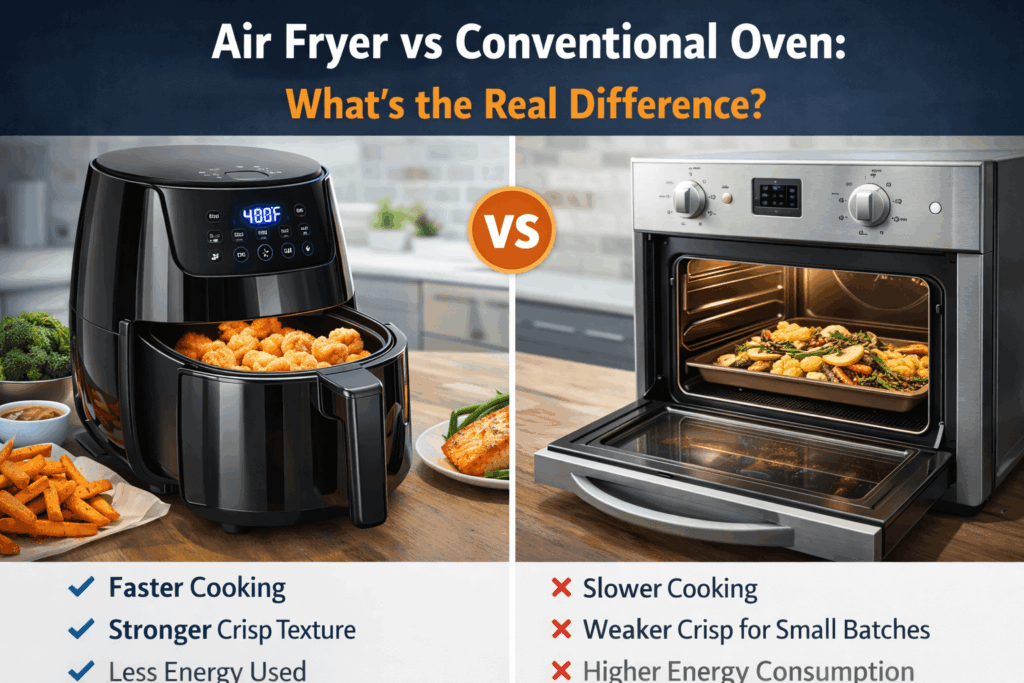
A full-size oven must heat a much larger space. It also loses more heat when the door opens. An air fryer has less air and fewer surfaces to warm, so it reaches its target temperature sooner.
The fan then pushes hot air over the food. This removes the cooler layer of air that naturally forms around moist food. As a result, heat reaches the food surface more quickly.
How an Air Fryer Works
An air fryer combines three basic parts:
- A heating element
- A fan
- A perforated basket or rack
The heating element warms the air. The fan moves that air around the food. The holes in the basket allow hot air to reach the bottom and sides of the food.
This design creates forced convection. “Forced” means the fan moves the air instead of allowing air to circulate on its own.
A conventional oven may also use convection. However, many standard ovens rely mainly on natural air movement. Even convection ovens usually have a larger chamber and more space between the fan, heating element, and food.
Why the fan matters
Food heats through several forms of heat transfer. In an air fryer, moving air increases convection at the food’s surface.
The moving air can:
- Deliver heat to the food faster
- Carry away surface moisture
- Help the food brown and crisp
- Keep the temperature around the food more even
This does not mean the fan cooks the center instantly. Heat must still move from the outside toward the center. Thick foods, frozen meats, and dense vegetables can still take time.
Why the small chamber matters
A full-size oven may hold several cubic feet of air. A typical basket-style air fryer holds much less. The smaller space requires less energy and less time to warm.
The air fryer also has less interior metal and fewer large surfaces to heat. When you open the door or basket, some heat escapes, but the appliance can often recover quickly.
The U.S. Department of Energy explains that smaller cooking appliances can use less energy than a full-size oven for small portions. The same basic size advantage helps explain why an air fryer often preheats faster.

The Food Is Closer to the Heat Source
In many air fryers, the heating element sits just above the food. This short distance allows radiant heat from the element to reach the upper surface quickly.
The basket also keeps food away from a solid pan. Hot air can move around more of the food instead of touching only the top and bottom.
A full-size oven can still brown food well, especially when it uses convection or a broiler. But the distance between the food and the heating source is often greater.
This is one reason air fryers work well for:
- French fries
- Chicken wings
- Tater tots
- Breaded fish
- Frozen snacks
- Small portions of vegetables
The design is less useful when you need to cook a large roast, a deep casserole, or several trays of food at once.
Why Air Fryers Crisp Food So Well
Air fryers do not “fry” food in the same way as oil in a deep fryer. They crisp food by using hot, moving air and a small amount of oil, if needed.
Crisping depends on surface moisture. While the surface remains wet, its temperature stays near the boiling point of water. Once enough moisture leaves, the surface can become hotter and develop browning.
The fan helps by carrying moist air away from the food. This supports browning reactions, including the Maillard reaction, which creates the brown color and savory flavor found on toasted and roasted foods.
A light coating of oil can improve browning and crispness. Too much oil may drip through the basket, smoke, or make the food greasy.
Faster does not always mean better
Air frying can make food crisp on the outside before the inside is ready. This can happen with:
- Thick chicken breasts
- Large potatoes
- Frozen foods with dense centers
- Whole sausages
- Large pieces of meat
Use a food thermometer when safety matters. The USDA recommends cooking poultry to 165°F, ground meats to 160°F, and whole cuts of beef, pork, lamb, and veal to 145°F, followed by a three-minute rest.
Check the current USDA safe minimum internal temperature chart for detailed guidance.

Air Fryer vs. Oven: What Makes the Biggest Difference?
The following factors usually control cooking speed more than the appliance label itself.
| Factor | Air fryer effect | Oven effect |
|---|---|---|
| Cooking chamber | Small and quick to heat | Large and slower to heat |
| Air movement | Strong airflow over the food | Low airflow in a standard oven |
| Food position | Often close to the heating element | Usually farther from the element |
| Basket or pan | Perforated, allowing airflow | Solid pan may block airflow |
| Capacity | Best for small batches | Better for large batches |
| Heat recovery | Often quick after opening | May take longer after the door opens |
| Crisping | Usually fast for small foods | Can be slower without convection |
The most important trade-off is capacity versus speed. An air fryer may finish one small batch quickly. A full-size oven may cook more food at one time, even if the first batch takes longer.
A simple example
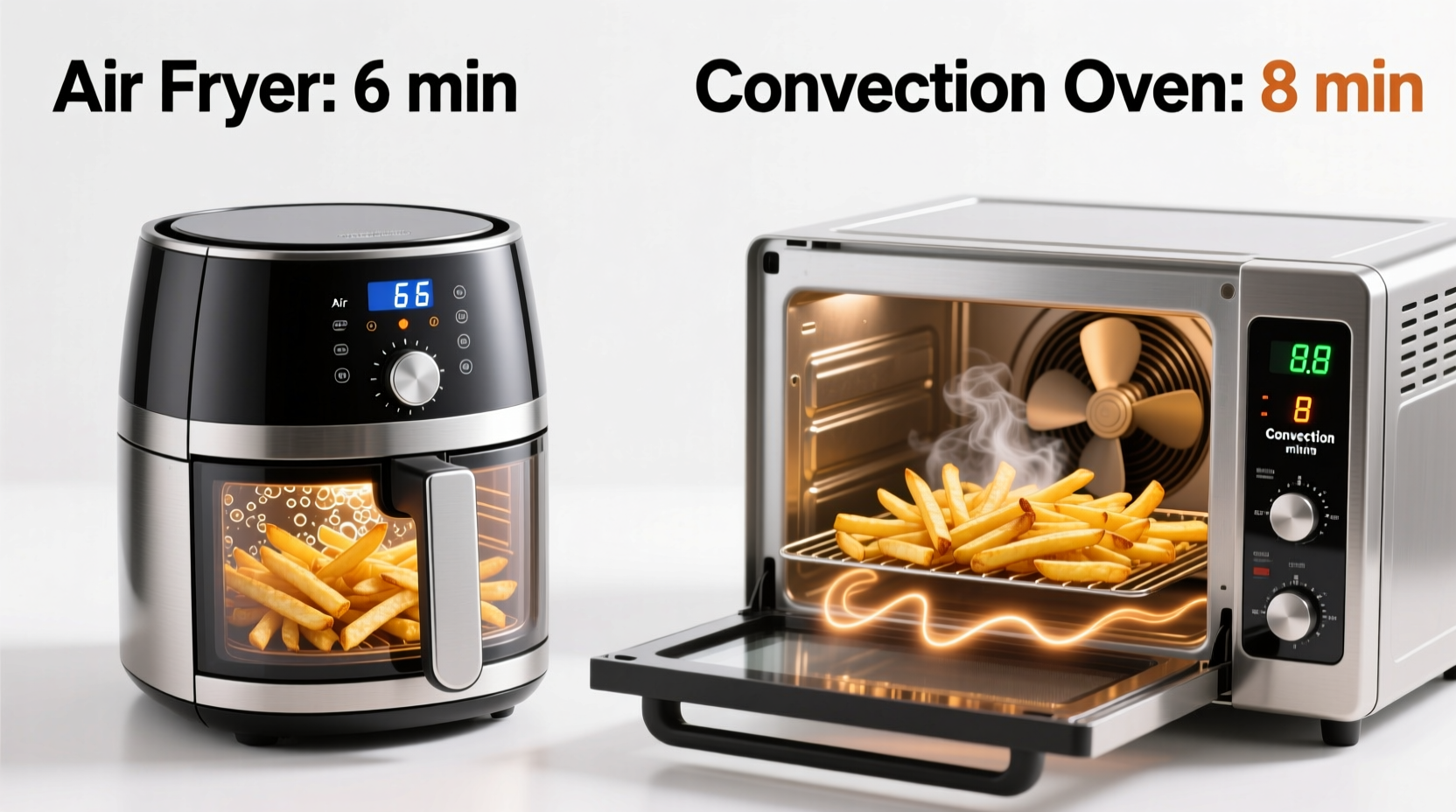
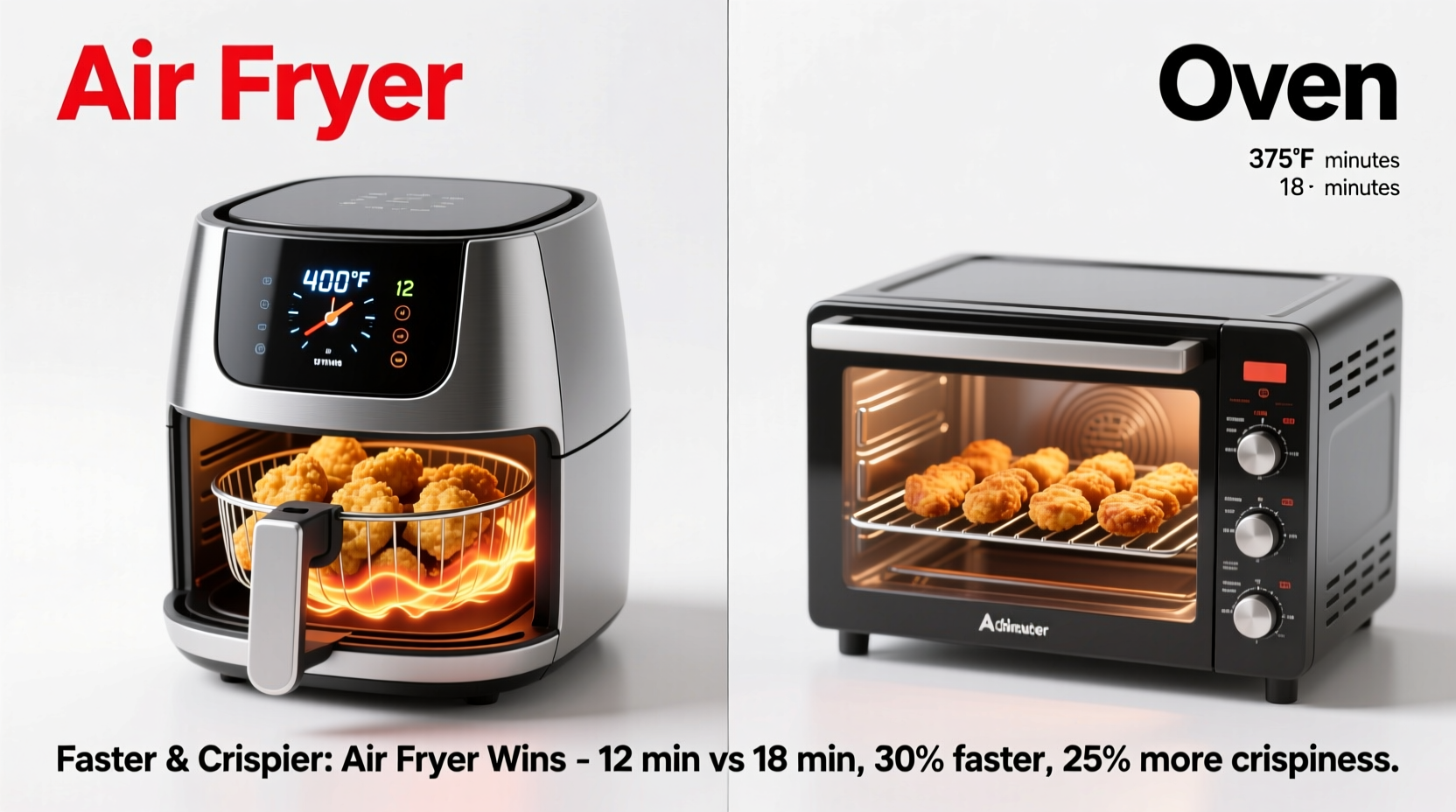
Suppose a small serving of frozen fries takes about 15 minutes in an air fryer. The same fries might need 20 to 30 minutes in a conventional oven, depending on the package directions and whether the oven is fully preheated.
That comparison is only an example. Air fryer models vary in fan power, basket shape, heating element placement, and temperature accuracy. Follow the food package instructions first, then adjust based on the result.
Why wattage does not tell the whole story
A common mistake is to compare only wattage. A higher-wattage appliance may produce more heat, but cooking speed also depends on:
- Airflow
- Chamber size
- Insulation
- Heating element position
- Basket design
- Food thickness
- Food load
- Starting temperature
An air fryer rated at 1,500 watts does not automatically cook twice as fast as a 750-watt appliance. Wattage describes electrical power, not a guaranteed cooking time.
How Much Faster Is an Air Fryer Than an Oven?
There is no single time difference for every recipe. A useful starting point is to reduce the oven temperature by about 25°F and begin checking the food earlier, often after reducing the listed time by roughly 20%.
This is a cooking estimate, not a rule. Some foods need a much larger adjustment, while others need almost none.
Practical adjustment example
If an oven recipe says:
- 400°F for 25 minutes
You might try:
- 375°F in an air fryer
- Start checking at about 18 to 20 minutes
Turn or shake the food if the recipe benefits from even browning. Use a thermometer for meat and poultry rather than relying only on color or time.
When the air fryer may not be faster
An air fryer may lose its speed advantage when:
- The basket is packed tightly
- You need several batches
- The food is very thick
- The appliance is not preheated when the recipe requires it
- The food is placed in a deep container
- You use a low temperature
- The air fryer has weak airflow
- You open the basket repeatedly
A large oven may be more efficient for a family-size meal. Cooking three batches of fries in an air fryer can take longer than cooking one large tray in a convection oven.
How to Use an Air Fryer for Faster, Even Cooking
Use these steps to get the main speed benefit without sacrificing food quality.
1. Check the food size
Cut food into pieces of similar size. Small, even pieces cook more evenly than a mix of thick and thin pieces.
For meat, thickness matters more than weight. A thick chicken breast can take much longer than several thin strips with the same total weight.
2. Preheat when it helps
Preheating can reduce cooking time for foods that need a hot surface right away, such as:
- Frozen fries
- Breaded foods
- Biscuits
- Pizza
- Small baked goods
Some air fryers heat so quickly that preheating makes little difference. Follow the appliance manual and package directions.
3. Keep space around the food
Place food in a loose, single layer when possible. Air must move around the pieces.
Do not fill the basket to the top unless the instructions allow it. A crowded basket traps moisture and blocks airflow. The result may be soft food and a longer cooking time.
4. Shake or turn the food
Shake small foods halfway through cooking. Turn larger pieces with tongs.
This exposes new surfaces to the hot air and helps reduce pale or soft spots.
5. Use a small amount of oil when suitable
A light oil coating can improve browning. Do not pour oil into the bottom of a basket-style air fryer unless the manual specifically permits it.
Use oils that tolerate the selected cooking temperature. Stop cooking if you see unusual smoke, and clean away built-up grease before using the appliance again.
6. Check doneness by more than time
Time is only an estimate. Check:
- Internal temperature for meat
- Tenderness for vegetables
- Browning for breaded food
- A firm texture for baked items
For meat and poultry, place the thermometer in the thickest part and avoid touching bone.
Common Air Fryer Mistakes That Slow Cooking
Overfilling the basket
Overfilling is the most common cause of slow, uneven cooking. The food releases moisture, but the crowded basket prevents that moisture from leaving quickly.
Cook in batches when crispness matters. A second batch may take more time, but it will often cook better than one overloaded batch.
Using a solid liner incorrectly
Parchment liners and silicone liners can reduce airflow if they cover too many basket holes. Use products made for air fryers and follow the package directions.
Never place loose parchment in the basket during preheating. The fan may lift it toward the heating element.
Adding wet food without preparation
Wet batter may drip through the basket or fail to set. A dry coating usually works better than a loose liquid batter in a basket-style air fryer.
Pat food dry when appropriate. This helps the surface brown and reduces steaming.
Ignoring the appliance manual
Air fryer controls are not identical. Some models heat from the top, while others use different fan and basket designs.
Read the manual for:
- Maximum fill lines
- Safe cookware
- Preheating instructions
- Cleaning requirements
- Smoke and grease warnings
- Foods that should not be used
Assuming every oven recipe converts exactly
An air fryer can cook faster, but it may also brown food sooner. Start checking early, especially when converting a recipe for the first time.

Is an Air Fryer More Energy-Efficient Than an Oven?
For a small amount of food, an air fryer often uses less energy than a full-size oven because it heats a smaller space and may run for less time. This is a reasonable physics-based conclusion and aligns with the U.S. Department of Energy’s guidance that smaller cooking appliances can be useful for small meals.
However, energy use depends on the entire cooking task. A full-size oven may be the better choice when you need to cook a large amount of food at once.
The fairest comparison considers:
- Appliance power in watts
- Total cooking time
- Preheat time
- Number of batches
- Amount of food cooked
- Whether the oven is already hot for another dish
For example, one 1,500-watt air fryer running for 20 minutes uses about:
1,500 watts × one-third of an hour = 500 watt-hours, before accounting for cycling and actual power use.
This is a simple estimate, not a laboratory measurement. The appliance may cycle its heating element on and off during cooking.
When Should You Use an Air Fryer Instead of an Oven?
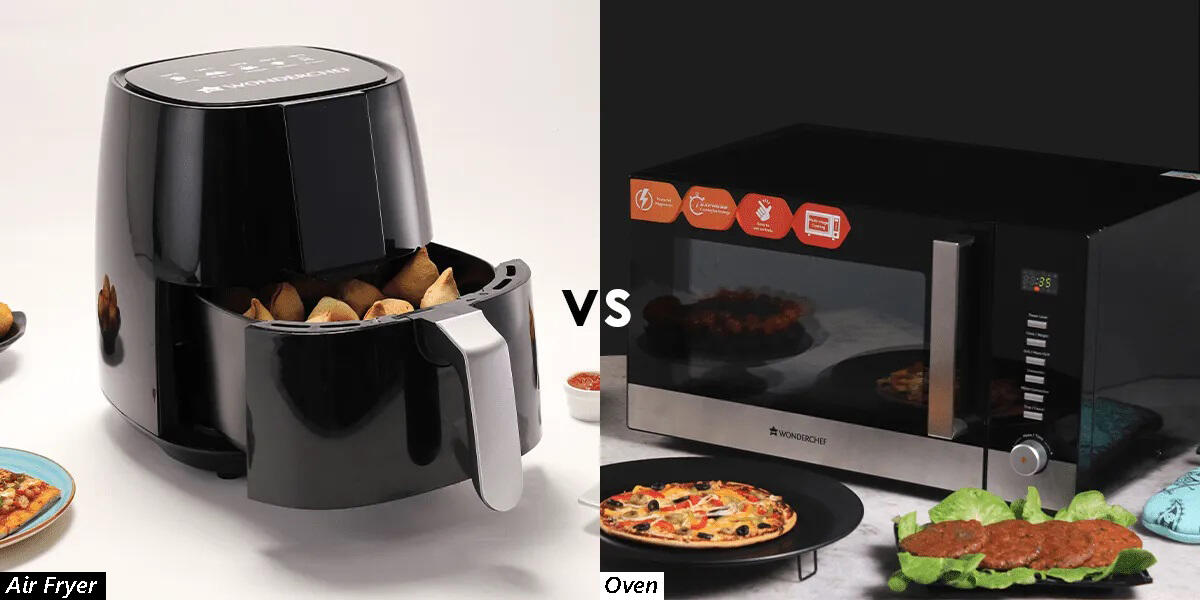
Choose an air fryer when you want:
- A fast small meal
- Crisp food with little oil
- Quick reheating
- A small portion of frozen food
- Less time spent waiting for preheating
- A cooler kitchen during warm weather
Choose a full-size oven when you need:
- Several servings
- Multiple dishes at once
- A large casserole
- A whole turkey or large roast
- Multiple racks of food
- More space for baking dishes
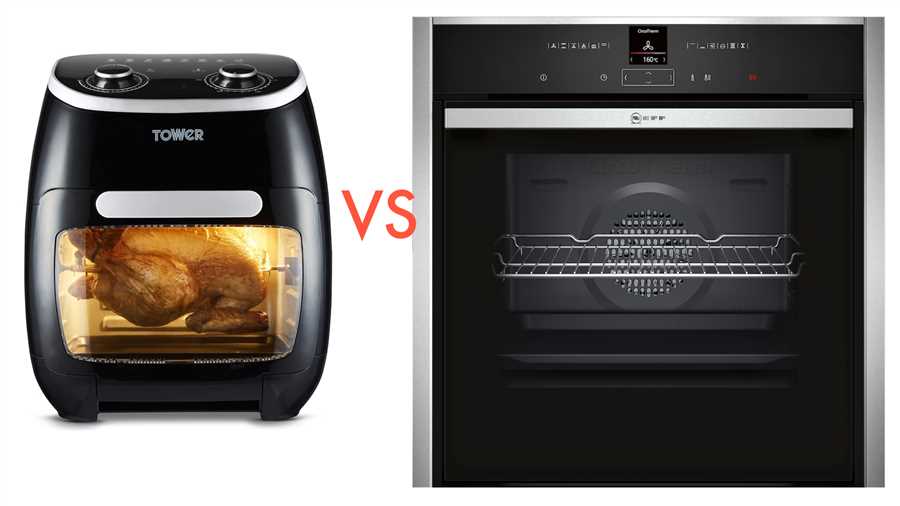
Choose a convection oven when you want some air-fryer benefits with more capacity. A convection oven may brown food well, but its larger chamber often takes longer to heat and may need a longer cooking time.
Frequently Asked Questions
Does an air fryer cook faster than a convection oven?
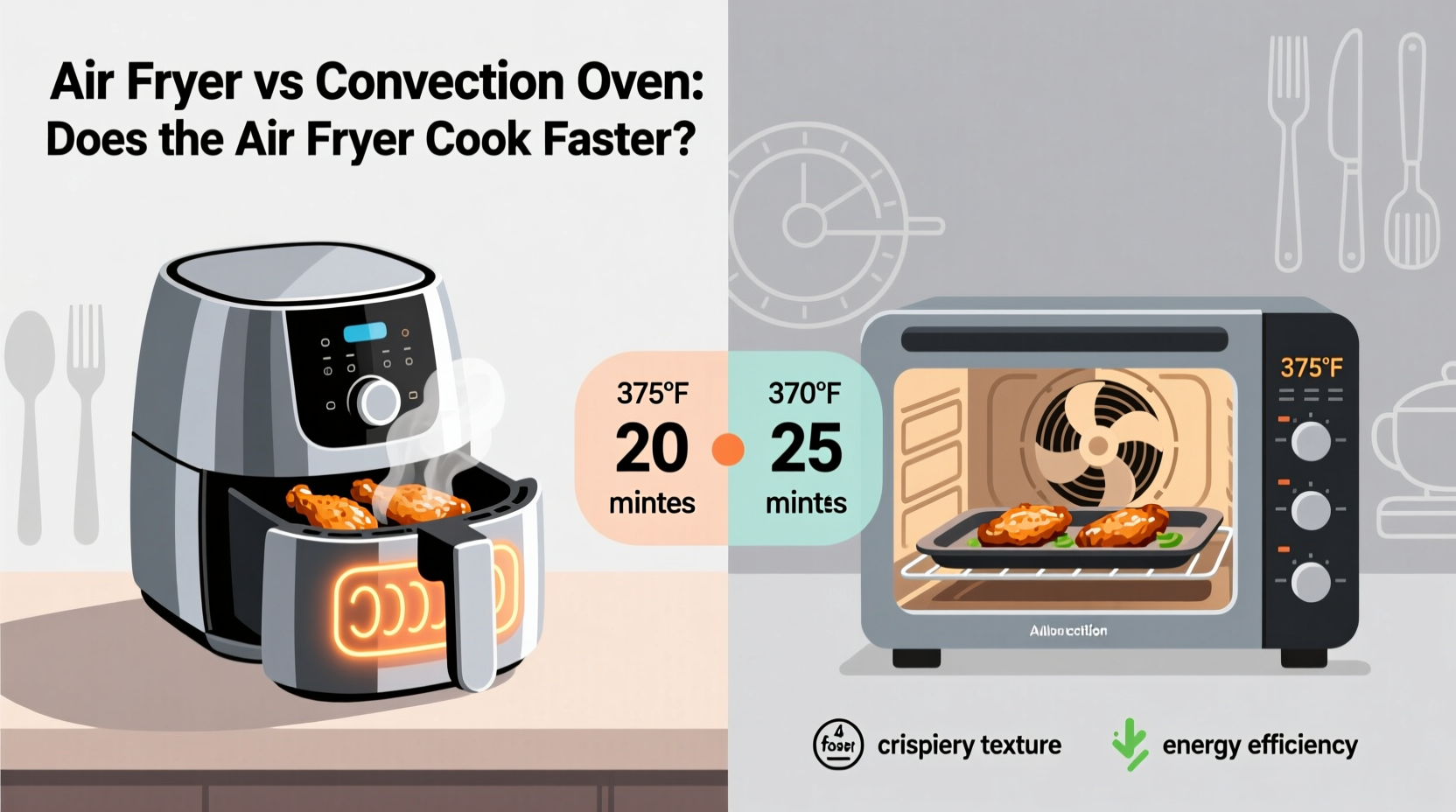
Often, but not always. Both use moving hot air. A basket air fryer usually has a smaller chamber and places food closer to the heating element, while a convection oven offers more space. For small portions, the air fryer often finishes first.
Do I need to preheat an air fryer?
Not always. Preheating can help foods that need immediate browning, such as fries or breaded items. For some foods, the difference is small. Follow the appliance instructions and recipe guidance.
Can I use oven cooking times in an air fryer?
Use oven directions as a starting point, not a guarantee. Try lowering the temperature by about 25°F and check the food 20% earlier. Adjust the next batch based on browning, texture, and internal temperature.
Why is my air fryer food taking so long?
The basket may be too full, the food may be too thick, the temperature may be too low, or the appliance may have weak airflow. Check that the basket is not blocked and that the food is arranged in a loose layer.
Is air-fried food healthier than oven-baked food?
The answer depends on the food and how it is prepared. Air frying can reduce the amount of oil used compared with deep frying, but it does not automatically make high-sodium, highly processed, or heavily breaded food healthy. Nutrition depends on the full recipe and portion.
Conclusion
An air fryer cooks faster than a conventional oven because it combines a small chamber, powerful airflow, close heating elements, and an open basket. These features transfer heat and remove surface moisture efficiently.
Its main advantage is speed for small portions. Its main limit is capacity. Keep food in a loose layer, check thick foods with a thermometer, and treat temperature conversions as starting points rather than fixed laws.
For a quick snack or small meal, use the air fryer. For a large meal or several dishes, the oven may still be the better tool.