Air Fryer Tripping Breaker: Causes And Safe Fixes
An air fryer usually trips a breaker because it overloads the circuit, has a fault, or shares power with another high-use appliance.
An air fryer tripping breaker can be annoying, but it is often a clear warning rather than a mystery. The breaker may be protecting your wiring from too much heat, a damaged cord, a faulty outlet, or an internal appliance problem. This guide explains the likely causes, safe checks, repair limits, and ways to prevent the problem from returning.
Why Is My Air Fryer Tripping the Breaker?
A circuit breaker trips when it detects too much electrical current or a dangerous fault. It shuts off power before wires become hot enough to damage insulation or start a fire.
Most kitchen circuits use 15-amp or 20-amp breakers. Many air fryers draw between 1,200 and 2,000 watts. On a 120-volt circuit, that equals about 10 to 17 amps.
You can estimate the current with this simple formula:
Current in amps = watts ÷ volts
For example:
• A 1,500-watt air fryer uses about 12.5 amps on a 120-volt circuit.
• A 1,800-watt air fryer uses about 15 amps.
• A 2,000-watt air fryer uses about 16.7 amps.
That load may be safe on its own, but it can overload the circuit when a microwave, toaster, coffee maker, rice cooker, or refrigerator starts at the same time. This is one of the most common reasons for an air fryer tripping breaker.
A breaker may also trip because of a short circuit, ground fault, loose connection, damaged plug, or defective heating element. The timing gives you a useful clue. A trip after several minutes often points to overload or heat buildup. An instant trip may suggest a short, ground fault, or serious appliance fault.
Common Causes of an Air Fryer Tripping Breaker
The circuit is overloaded
An air fryer may share a circuit with several other outlets. You may not know which outlets are connected to the same breaker because kitchen wiring can pass through many locations.
For example, you might run an air fryer while a microwave heats food and a coffee maker warms water. Each appliance works normally on its own, but the combined load exceeds the circuit rating.
This causes the breaker to trip as designed. The air fryer may not be defective at all.
Another high-wattage appliance is running
Some appliances use a large amount of power for a short time. Common examples include:
• Microwave ovens
• Electric kettles
• Toaster ovens
• Coffee makers
• Electric griddles
• Portable heaters
• Dishwashers
• Garbage disposals
• Refrigerators during compressor startup
If your air fryer tripping breaker problem happens only when another appliance is running, the shared load is a strong suspect.
The air fryer has a damaged cord or plug
Inspect the power cord before using the appliance again. Look for cuts, melted areas, exposed wires, bent prongs, dark marks, or a loose connection where the cord enters the air fryer.
A damaged plug can create heat or a short circuit. Do not wrap damaged wiring with tape and keep using it. Tape is not a safe repair for a high-wattage kitchen appliance.
The outlet is damaged or worn
An old outlet may not hold the plug tightly. A loose connection can create resistance and heat. You may notice:
• A plug that falls out easily
• Crackling or buzzing
• Brown or black marks
• A warm outlet cover
• A burning smell
Stop using the outlet if you notice any of these signs. An electrician should inspect it.
A GFCI device is tripping
Many kitchens use ground-fault circuit interrupter protection. A GFCI trips when it detects a small difference between the current leaving and returning through the circuit.
This protection helps reduce shock risk near water. However, repeated GFCI trips can point to moisture, leakage inside the appliance, a wiring issue, or a faulty GFCI device.
If the reset button will not stay in, do not force it. Unplug the air fryer and investigate the cause.
The air fryer has an internal electrical fault
Air fryers contain heating elements, fans, electronic controls, thermal cutoffs, and wiring. Any of these parts can fail.
A fault may appear when the heating element becomes hot. This explains why an air fryer may run for five minutes before tripping the breaker. It may also trip when the fan starts, when the temperature rises, or when the basket switch activates.
Repeated trips with the air fryer as the only load strongly suggest an appliance problem.
Moisture has entered the appliance
Water and electricity are a dangerous mix. Moisture can enter through cleaning, spills, steam, or a wet basket that was placed back into the unit.
Unplug the air fryer and let it dry fully in a safe, dry place. Never spray cleaner into the appliance or immerse the main unit in water. If the breaker still trips after the unit dries, stop testing it.
The breaker is weak or faulty
Breakers can wear out, though this is less common than an overload or appliance fault. A weak breaker may trip below its normal rating or feel unusually hot.
Do not replace a breaker with a larger one to stop an air fryer tripping breaker issue. The wire may not be rated for the larger breaker, creating a serious fire risk.

How to Troubleshoot an Air Fryer Safely
Use a calm, step-by-step process. Do not keep resetting the breaker again and again. A trip is a warning, not an inconvenience to defeat.
1. Unplug the air fryer
Turn the air fryer off and unplug it from the wall. Do not pull the cord by the cable. Hold the plug instead.
Wait a few minutes before resetting the breaker. If the breaker feels hot, smells burnt, or will not reset, leave it off and call a qualified electrician.
2. Check the air fryer and plug
Look for visible damage, grease buildup near the plug, melted plastic, or a loose cord. Check the air fryer housing for cracks or burn marks.
Do not open the appliance. Internal repairs require electrical knowledge and may create shock or fire hazards. Opening the unit can also cancel the warranty.
3. Identify the circuit load
Turn off or unplug other high-wattage appliances on the same circuit. Then reset the breaker once.
If the breaker stays on with the air fryer unplugged, that does not prove the air fryer is safe. It only tells you that the air fryer may be involved.
4. Try a different circuit carefully
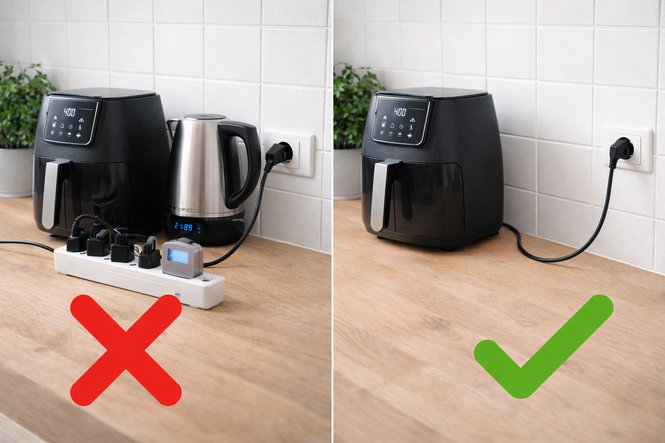
If the air fryer looks undamaged, you can test it on a different wall outlet that is known to be on another circuit. Do not use an extension cord, power strip, or multi-plug adapter for this test.
Run the air fryer briefly while no other high-wattage appliance is active. Stay nearby and stop immediately if you notice heat, smoke, odor, noise, or another trip.
If the air fryer trips more than one circuit, discontinue use. The appliance likely needs professional testing or replacement.
5. Check the outlet for warning signs
The outlet should be cool, secure, and free from scorch marks. The plug should fit firmly without wobbling.
Never use an outlet that is wet, cracked, loose, or discolored. A licensed electrician can check the receptacle, wiring, breaker, and grounding.
6. Check the rating label
Find the label on the air fryer, usually on the back or bottom. Note the wattage and voltage.
Compare the wattage with the circuit and other appliances. A 1,800-watt air fryer can use nearly the full capacity of a 15-amp circuit, leaving little room for other loads.

Can You Use an Air Fryer on an Extension Cord?
In most cases, you should plug an air fryer directly into a properly grounded wall outlet. Manufacturers often warn against using extension cords because air fryers draw high current for long periods.
A light-duty extension cord can heat up under this load. A power strip may also overheat, especially when other appliances are connected.
If the manufacturer allows an extension cord, use only a short, grounded cord with a current rating that meets or exceeds the air fryer’s requirements. The cord should be fully uncoiled and rated for appliance use.
Avoid:
• Thin indoor extension cords
• Damaged or warm cords
• Power strips with several appliances
• Extension cord adapters that remove grounding
• Cords placed under rugs or rugs near heat
An extension cord does not solve an overloaded circuit. It only moves the connection point. If an air fryer tripping breaker problem continues, focus on the circuit and appliance rather than adding more accessories.

How to Prevent an Air Fryer From Tripping the Breaker
Prevention starts with managing electrical load. Think of a circuit like a small road. One large truck may pass safely, but several large trucks at once can cause a traffic jam.
Use a dedicated wall outlet
Plug the air fryer directly into a wall outlet. Avoid sharing that outlet with another high-wattage appliance.
A dedicated 20-amp circuit may be useful for a busy kitchen, but an electrician should confirm that the wiring, breaker, outlet, and installation all match. A 20-amp breaker must not be installed simply because a 15-amp breaker trips.
Avoid running several heating appliances together
Plan cooking times so the air fryer does not run at the same time as a microwave, toaster oven, kettle, or portable heater.
This small habit often solves an air fryer tripping breaker issue caused by normal circuit overload.
Keep the appliance dry
Wash removable parts according to the manual, but keep the main electrical unit dry. Dry the basket and tray before placing them back inside.
Allow steam to escape as directed. Do not cover vents, and do not operate the air fryer near standing water.
Clean it correctly
Grease and food debris can produce smoke and unusual smells. They may also affect airflow and cause the appliance to run hotter.
Clean the basket, tray, and interior surfaces as the manual instructs. Never pour water into the main housing or use abrasive tools near electrical parts.
Replace aging or damaged appliances
An air fryer is not worth risking a kitchen fire. If it repeatedly trips breakers, has a damaged cord, smells like burning plastic, or shows scorch marks, replace it or have it tested by a qualified repair professional.
The cheapest safe choice is not always the lowest-priced repair. Consider the appliance’s age, warranty, repair cost, and condition.

When Should You Call an Electrician?
Call an electrician if the breaker trips with the air fryer unplugged or if several outlets lose power. You should also get professional help when you notice heat, sparks, burning smells, loose outlets, or damaged wiring.
An electrician can test:
• Circuit amperage and load
• Breaker operation
• Outlet connections
• Grounding and polarity
• GFCI protection
• Voltage under load
Do not remove the electrical panel cover unless you are trained and legally permitted to do so. Parts inside can remain energized even when the main breaker is off.
Call emergency services if you see smoke, flames, or active arcing. Turn off power only if you can do so without touching damaged equipment or entering danger.
A useful lesson from appliance troubleshooting is to separate the appliance from the building. Test the air fryer only in safe, controlled ways. If the problem follows the appliance, stop using it. If the problem stays with one outlet or circuit, the home wiring needs attention.

When Is the Air Fryer the Problem?
The air fryer is more likely to be at fault when:
• It trips multiple circuits
• It trips immediately after being turned on
• It trips even when used alone
• The cord or plug is damaged
• The appliance smells burnt
• The housing becomes unusually hot
• The fan makes abnormal sounds
• The breaker trips after the heating element activates
A single trip during a busy cooking session does not prove the air fryer is broken. Repeated trips are different. They indicate that you should stop using the appliance until the cause is known.
Do not bypass a safety switch, remove the ground pin, or use a higher-rated breaker. These shortcuts hide the warning and can expose you to electric shock or fire.

When Is the Home Circuit the Problem?
The home circuit is more likely to be at fault when:
• The breaker trips with several different appliances
• The outlet feels warm
• Lights dim when the air fryer starts
• The breaker will not reset
• Multiple outlets stop working
• The outlet is loose or discolored
• The circuit already powers many appliances
Older homes may have limited kitchen capacity or shared circuits that do not match modern appliance use. A professional can determine whether a new circuit, outlet repair, breaker replacement, or load change is appropriate.
Do not assume that a new air fryer caused the problem just because the issue appeared after you bought it. The air fryer may have revealed a circuit that was already close to its limit.

Air Fryer Tripping Breaker vs. GFCI Tripping
A standard breaker mainly protects wiring from overcurrent. A GFCI protects people from certain ground-fault shock risks.
These devices can look similar during a trip, but the reset location may differ. A breaker is usually in the electrical panel. A GFCI reset button may be on an outlet or another outlet upstream on the same circuit.
A GFCI trip does not always mean the air fryer uses too much power. It may indicate current leaking through moisture or damaged insulation.
Reset the GFCI only once after unplugging the appliance. If it trips again, stop using the air fryer and arrange an inspection. Repeated resets can turn a useful safety warning into a dangerous habit.

Mistakes to Avoid
Many people make the same mistakes when dealing with an air fryer tripping breaker problem. Avoid these common errors:
• Repeatedly resetting the breaker without finding the cause
• Using a larger breaker than the circuit wiring allows
• Plugging the air fryer into a cheap power strip
• Removing the ground pin from the plug
• Testing the appliance with wet hands
• Ignoring a burning smell or warm outlet
• Opening the air fryer without proper training
• Continuing to use it after trips on several circuits
• Assuming a circuit is safe because the breaker eventually resets
A breaker that resets is not necessarily a healthy breaker. It may simply be waiting for the problem to happen again.
Frequently Asked Questions About Air Fryer Tripping Breaker
Why does my air fryer trip the breaker after a few minutes?
A delayed trip often means the circuit is overloaded or heat is building in a weak connection. Check whether another high-wattage appliance is running, and stop using the air fryer if the problem continues when it is alone.
Can an air fryer trip a 15-amp breaker?
Yes. A high-wattage air fryer can use most of a 15-amp circuit’s capacity. If another appliance shares the circuit, the combined load may cause the breaker to trip.
Should I plug my air fryer into a power strip?
Usually, no. Air fryers draw substantial power, so a direct connection to a suitable wall outlet is safer and is commonly recommended by manufacturers.
Is the air fryer dangerous if it trips the breaker once?
One trip during heavy kitchen use may result from a normal overload. However, repeated trips, burning odors, sparks, heat, or visible damage mean you should stop using the appliance and seek professional help.
Can I use a higher-amp breaker to stop the problem?
No. A higher-rated breaker may allow wiring to overheat before the breaker trips. Only a qualified electrician should select or replace a breaker after checking the circuit wiring and design.
Why does my air fryer trip the GFCI outlet?
A GFCI trip may result from moisture, current leakage, a damaged cord, or an internal fault. Unplug the air fryer and do not keep resetting the GFCI if it trips again.
Will cleaning the air fryer stop it from tripping the breaker?
Cleaning food and grease may improve airflow, but it will not fix damaged wiring, a bad heating element, or a faulty outlet. Clean only as the manual directs, and keep the main electrical unit dry.
Conclusion
An air fryer tripping breaker usually points to an overloaded circuit, a faulty outlet, damaged wiring, or an appliance defect. Start by unplugging the air fryer, removing other heavy loads, checking for visible damage, and avoiding extension cords or power strips.
Never bypass the breaker or install a larger one as a quick fix. If the air fryer trips more than one circuit, or if you notice heat, smoke, sparks, or a burning smell, stop using it and call a qualified professional. Use these checks to protect your kitchen, then explore your appliance manual or share your experience in the comments.